Most of us first meet electronic sound through order.
A keyboard, predictable pitches, clean envelopes..The comfort of knowing that if you press a key, the machine will answer in a language you already understand.
I approached synthesis the same way.
Coming from years of deterministic systems, strict codebases, expected outcomes, clean control flow; the Moog approach felt quite familiar. It is subtractive, controlled, and readable. You start with something rich and carve it into shape.
Then you encounter the other coastline.
Two Coastlines, Two Philosophies
In the mid-1960s, two very different instruments were being born on opposite sides of the United States.
In Upstate New York, Bob Moog was designing synthesizers for traditional musicians. In San Francisco, Don Buchla was working with the San Francisco Tape Music Center and composers like Morton Subotnick and Pauline Oliveros. One path aimed at accessibility and control. The other deliberately rejected the familiar.
East Coast (Moog): Subtractive Order & The Familiar Keyboard
Moog attached a piano-style keyboard to his instruments. This single decision made the intimidating world of voltage-controlled electronics accessible to classical and jazz musicians. The keyboard was a bridge.
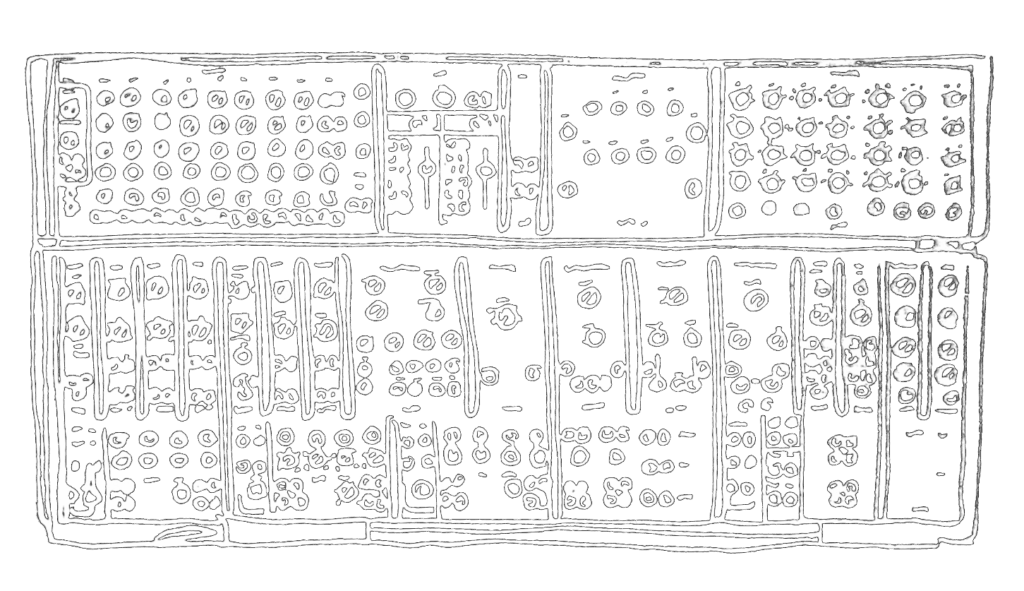
The architecture was subtractive: start with harmonically rich waveforms (sawtooth, square) and carve them down using a resonant low-pass filter and ADSR envelope generators. The signal path is linear and predictable: VCO -> VCF -> VCA.
The mindset is deterministic. You press a key and receive a stable pitch. The instrument is there to serve melody, harmony, and performance discipline.
West Coast (Buchla): Additive Chaos & The Organic Touchplate
Buchla refused the piano keyboard. He considered it a historical bottleneck that forced new electronic possibilities into old European musical habits. Instead he built touch-sensitive plates, pressure sensors, and complex voltage-control systems.
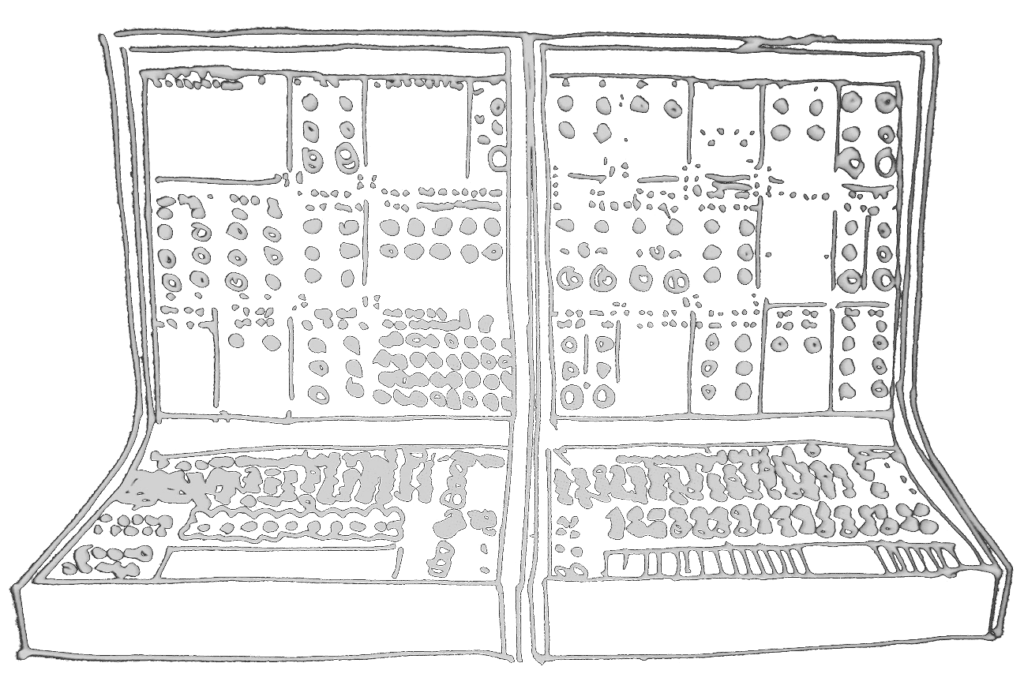
The architecture leans additive and non-linear: begin with simple sine waves and generate complexity through frequency modulation, wavefolding, and Low-Pass Gates (vactrol-based circuits that produce natural-sounding decays). Randomness is not an afterthought; it is designed in through sources of uncertainty and probability-based voltages.
The mindset is exploratory and “random”. You do not so much “play” the instrument as patch a system and negotiate with it. The machine is allowed a degree of agency.
Technical Contrast
| Feature | East Coast (Moog) | West Coast (Buchla) |
| Primary Goal | Melody, harmony, traditional performance | Timbre, acoustic behavior, sonic exploration |
| Input Method | Chromatic keyboard (12-TET scale) | Touch plates, pressure, voltage grids, sequencers |
| Core Engine | Subtractive (VCO -> VCF -> VCA) | Additive / Wavefolding (Sine -> Complex spectra) |
| Filter / Gate | Resonant Low-Pass Filter | Low-Pass Gate (Vactrol-based natural acoustic decay) |
| Randomness | Sample & Hold | Source of Uncertainty (Probability-based voltages) |
| Relationship to instrument | Performer controls the machine | Performer negotiates with the system |
Synthesis Waveform Visualizer
Order, Chaos, and the Shift in Posture
Most technical careers begin in Moog mode.
You learn the established interface. You play the expected scales. You optimize for predictable, reviewable, deterministic results. The corporate ladder, the clean commit, the well-behaved driver — all of it rewards the keyboard.
Moving into independence is closer to West Coast thinking.
You remove the familiar interface. You accept uncertainty as a feature rather than a bug. You build custom patches between things that were not designed to connect. You stop asking the system to behave and start listening to what it actually does when you stop forcing it.
The shift is not only technical. It is a change in posture: from controlling the instrument to entering into a relationship with voltage, chance, and timbre.
Listening
East Coast reference: Wendy Carlos – Switched-On Bach (1968). Precision, order, and the Moog used in service of the classical canon.
West Coast reference: Morton Subotnick – Silver Apples of the Moon (1967). Composed on a Buchla 100, generative, non-keyboard, and still alien nearly sixty years later.
Modern instruments such as the Buchla Music Easel or Make Noise 0-Coast continue to carry pieces of both traditions, but the philosophical tension remains.
Both approaches are valid, one offers mastery through control, the other requires you to give up the map.
Illustrations
Both synthesizer illustrations are sketches from the book 'Synthesizer Evolution: From Analogue to Digital (and Back)' by Oli Freke. (Highly recommended if you want both historical context and beautiful visual reference.)